When I finally splurged on fresh porcini, I paid more than I’d like to admit for a small paper bag of them at a farmers’ market. Then I watched two of the five go soft in my fridge before I got around to cooking them. That loss is what pushed me into drying porcini mushrooms, and I’ve never looked back. A jar of dried slices now sits on my pantry shelf all year, ready to turn a weeknight pot of lentils into something that tastes like it simmered all day.
In this guide, I’ll walk you through everything I’ve learned. We’ll cover how to source porcini safely, clean and slice them, dry them three different ways, and store them so they last. You’ll also learn how to bring them back to life in the kitchen, what the research says about their nutrition, and the ragù recipe my family requests most.
Porcini 101: Why Drying Porcini Mushrooms Deepens Their Flavor
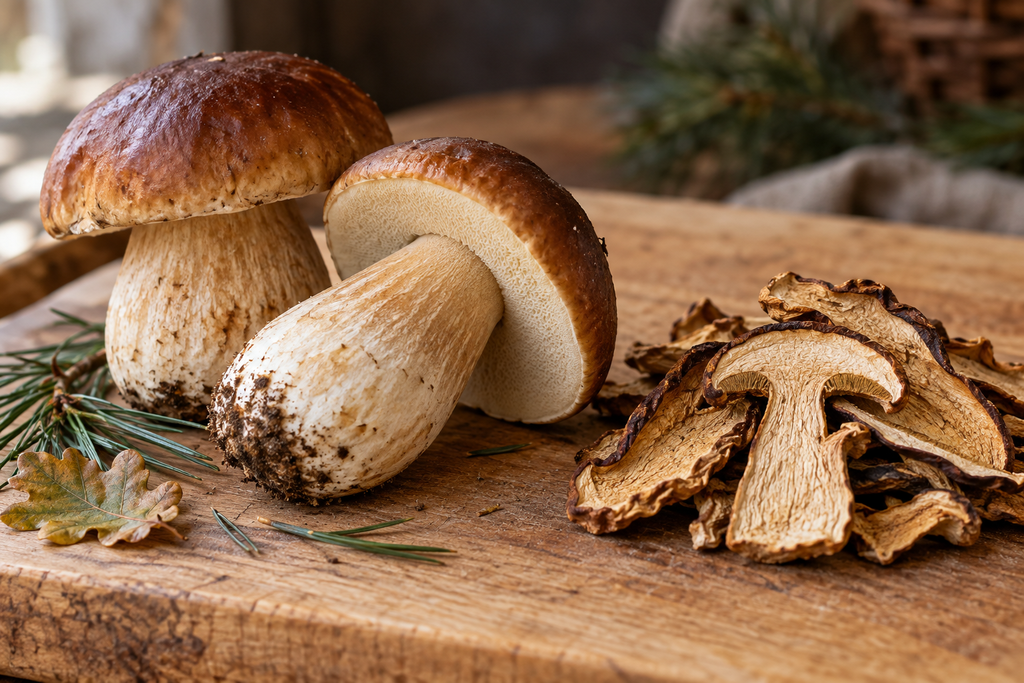
Porcini are the fruiting bodies of Boletus edulis and a few close relatives, including Boletus pinophilus and Boletus aereus. Instead of gills, they have a spongy layer of tiny pores under the cap. They grow in partnership with trees like pine, spruce, oak, and chestnut. Italians call them porcini, the French call them cèpes, and English speakers sometimes call them king boletes or penny buns.
Like most mushrooms, fresh porcini are roughly 90 percent water. When that water evaporates, the aroma compounds and naturally savory glutamates stay behind in a much smaller package. Drying also builds new flavor: the slices turn toasty and nutty, with a depth fresh porcini simply don’t have.
That’s why so many cooks, me included, often prefer dried porcini to fresh in braises, sauces, and stews. A quarter-ounce can perfume an entire pot.
Sourcing Porcini Safely
I buy fresh porcini from specialty grocers, reputable online mushroom suppliers, and a market vendor who works with licensed foragers. Before I start drying porcini mushrooms, I want to know exactly where they came from and which species they are. A trustworthy seller can answer both questions without hesitation.
Please take this part seriously. Several boletes resemble porcini, and some cause severe digestive illness. More broadly, misidentified wild mushrooms send people to the hospital every year, and some species are deadly. Only eat wild mushrooms that have been positively identified in person by an expert, such as an experienced member of a local mycological society. A photo-identification app or an online forum is not enough. If there’s any doubt, throw it out.
If fresh porcini aren’t available where you live, good-quality dried porcini from a brand that lists the species on the label are a great option. The storage and rehydrating sections below apply to them too.
Choosing and Cleaning Fresh Porcini
Choose porcini that feel firm and heavy for their size, with solid stems. Young porcini have white to cream-colored pores. Older ones turn greenish-yellow and spongy, and that pore layer dries poorly and can turn slimy, so I peel it away or pass on those mushrooms.
Next, check for insect larvae, which love porcini as much as we do. Slice one mushroom lengthwise and look for tiny tunnels, especially near the stem base. I cut away any tunneled sections and compost heavily infested mushrooms. Drying won’t make them any more pleasant to eat.
For cleaning, skip the water bath. Soaking is the fastest way to sabotage drying porcini mushrooms, because those sponge-like pores absorb water and dramatically lengthen drying time. Instead, I use a soft mushroom brush or a barely damp paper towel to wipe off soil and needles. Then I trim away the dirty base of the stem with a paring knife.
Slicing for Even Drying
I slice porcini lengthwise through both cap and stem, about ¼ inch (6 mm) thick. Cutting this way gives each slice the classic porcini silhouette, which looks beautiful in the jar and in finished dishes.
Consistency matters more than hitting an exact measurement. When slices vary in thickness, the thin ones over dry and crumble while the thick ones stay leathery in the middle. A sharp chef’s knife works well. A mandoline with a hand guard is even faster for a large haul.
If a mushroom has a very large cap and a thick stem, I sometimes slice them separately so each piece stays close to the same ¼-inch thickness. Lay the slices out as you go so you can spot any strays that need trimming.
Three Methods for Drying Porcini Mushrooms
I’ve used a dehydrator and a low oven for drying porcini mushrooms. Both let me control the heat and check the slices as they dry. You may also see instructions for air-drying porcini, but I don’t recommend relying on that method for home storage: humidity and drying time are much harder to control. Food preservation guidance recommends drying vegetables indoors with an oven or dehydrator.
Using a Food Dehydrator
Arrange the slices in a single layer with a little space between them so air can circulate. Set the dehydrator to 125°F (52°C). Depending on thickness, your machine, and the humidity in your kitchen, drying may take 6 to 10 hours or longer. Rotate the trays if your machine dries unevenly. Let a slice cool before testing it: it should be crisp and break rather than bend. If it is still flexible, keep drying.
Using a Low Oven with the Door Ajar
Set your oven to its lowest setting, ideally 140 to 150°F (60 to 65°C). Lay the slices on a wire rack set over a sheet pan. Prop the oven door open according to your oven manufacturer’s guidance so moisture can escape, and use a fan nearby to improve air circulation. Check and turn the slices regularly. Oven drying can take several hours; use the cooled-slice test rather than the clock to decide when they’re done. Keep children and pets away from the open oven.
Why I Don’t Rely on Air-Drying
A screened tray in a dry, breezy room may sound simple, but damp conditions can leave porcini moist long enough for mold to develop. Since drying porcini mushrooms is meant to preserve them, I use a dehydrator or low oven for batches I plan to keep in the pantry. If slices show any mold while drying, discard them.
How to Tell Your Porcini Are Fully Dry
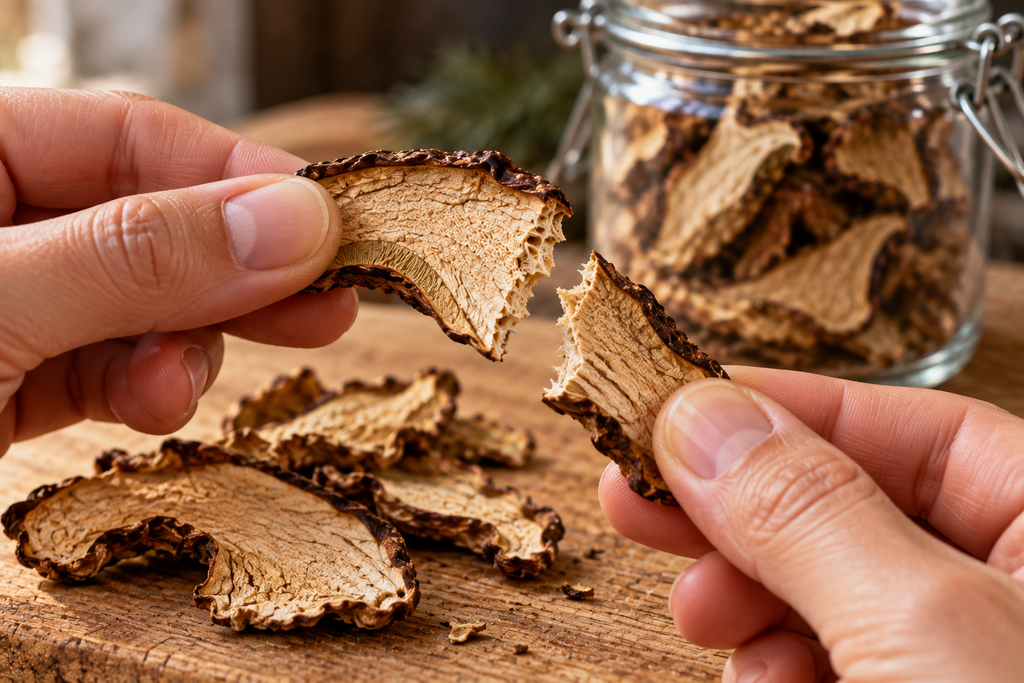
Properly dried porcini are crisp and brittle, and a slice should snap cleanly when you bend it. If it bends like leather, there’s still moisture inside, and that moisture can lead to mold once the slices are sealed in a jar.
Always test a slice after it has cooled for a few minutes. Warm slices feel softer than they really are.
Expect a dramatic shrink. Because porcini lose around 90 percent of their weight, 1 pound (450 g) of fresh mushrooms yields only about 1½ to 2 ounces (45 to 55 g) dried. The first time I weighed my harvest, I was surprised how small the pile looked. Then I tasted one and understood where all that flavor had gone.
Common Mistakes When Drying Porcini Mushrooms
The mistake I see most often is crowding the trays, which traps humidity and slows everything down. Another is turning the heat up to speed things along. High heat can cause case hardening, where the outside dries hard and seals moisture inside.
Sealing slices in a jar while they’re still warm creates condensation. Mixing a finished batch with a slightly under dried one puts the entire jar at risk. And skipping the larvae check means you may find unwelcome surprises later.
Storing Dried Porcini So They Last
Let the dried slices cool completely before packing them. Because they should be crisp and brittle, they do not need the week-long conditioning step used for dried fruit. Put them in clean, airtight jars, label each jar with the date, and store them in a cool, dark, dry cupboard. Check occasionally for moisture or signs of spoilage.
If you notice condensation soon after packing and there is no sign of spoilage, return the slices to the dehydrator and dry them thoroughly before cooling and packing them again. Discard any batch with mold, a musty smell, or visible insect activity.
Properly dried foods can retain good quality for up to about a year when sealed against moisture and kept cool, dark, and dry. Flavor may fade sooner, so I use my porcini while their aroma is still strong. I’ve removed the 48-hour freezer step here because the guidance I found for that treatment addresses dried fruit or herbs, rather than specifically supporting it for porcini.
Rehydrating Dried Porcini and Saving the Liquid
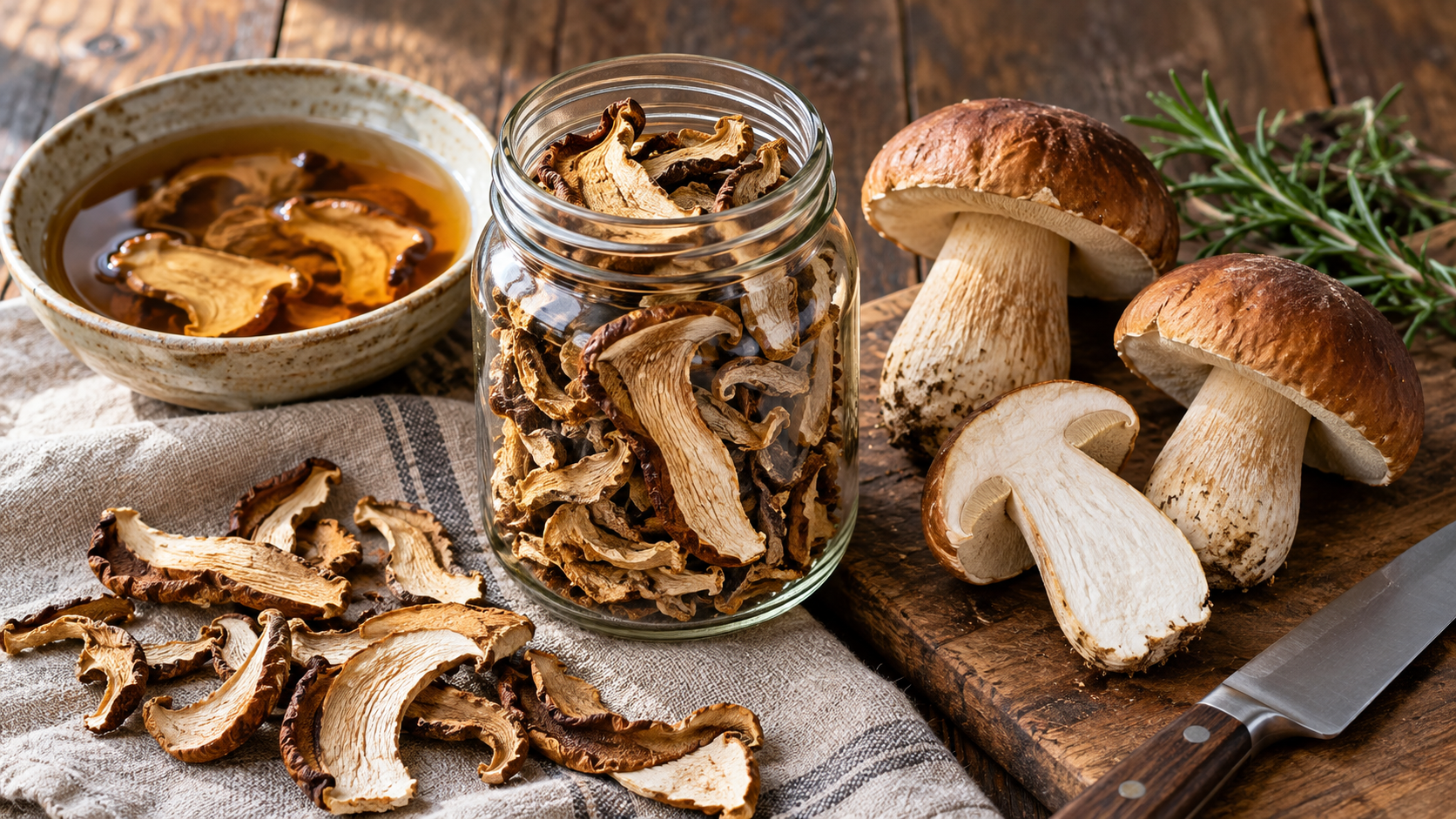
To rehydrate porcini, place them in a bowl and add enough warm water to cover them. About 1 cup (240 ml) per 1 ounce (28 g) is a useful starting point for many dishes; use more when the soaking liquid will become part of a soup or sauce. Let them soak for 20 to 30 minutes, until pliable. Lift them out with a slotted spoon, squeeze them gently over the bowl, and chop as needed.
Don’t pour the soaking liquid down the drain. Grit may settle at the bottom, so pour the liquid slowly, leaving the last spoonful behind, and strain it through a coffee filter or a paper-towel-lined sieve. In the ragù below, I use 2 cups (480 ml) for 1 ounce (28 g) because that liquid also helps cook the lentils. Cook the rehydrated porcini before serving.
The Nutrition Behind Dried Porcini
A serving of dried porcini is usually small, around 10 to 15 grams. Drying removes water, so nutrients become more concentrated by weight, but a small serving will still make a modest contribution to a meal. Mushroom nutrient values also vary by species and growing conditions. For specific figures, check the relevant entry in USDA FoodData Central and make sure it describes the type and form of mushroom you’re discussing.
Ergothioneine and the Vitamin D Question
Porcini contain ergothioneine and glutathione. In a 2017 study published in Food Chemistry, researchers measured these compounds in different mushrooms and found particularly high amounts in porcini. That is an interesting finding about the mushrooms’ composition; it does not establish that eating a serving prevents disease.
Mushrooms can produce vitamin D₂ after exposure to ultraviolet light. I wouldn’t count on an ordinary packet of dried porcini as a vitamin D source unless its label provides a vitamin D amount. I use porcini primarily for their rich flavor.
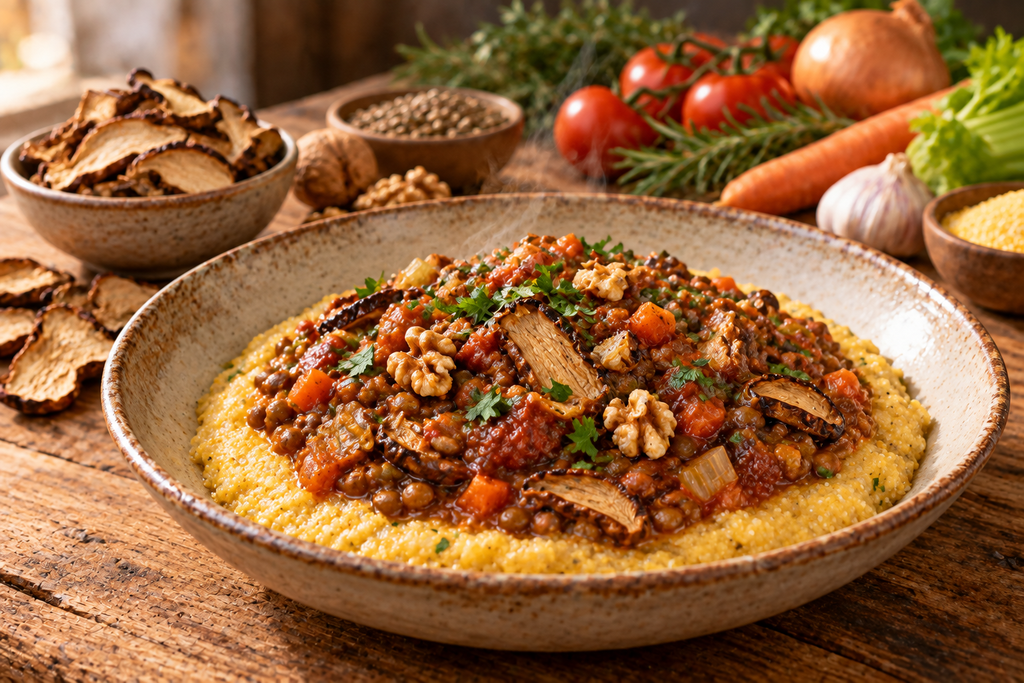
Forest Floor Ragù with Porcini, Lentils, and Toasted Walnuts
I created this ragù on a cold evening when I wanted something as rich as a meat sauce without the meat. The porcini and their soaking liquid give the sauce its depth, while lentils and walnuts make it hearty.
Serves: 4
Prep time: 35 minutes, including soaking
Cook time: 45 minutes
Ingredients
For the ragù:
- 1 oz (28 g) dried porcini
- 2 cups (480 ml) hot water, for soaking
- 1 tbsp (15 ml) extra-virgin olive oil
- 1 medium yellow onion, finely diced
- 1 medium carrot, finely diced
- 1 celery stalk, finely diced
- 3 garlic cloves, minced
- 1 tsp fresh rosemary, finely chopped
- 2 tbsp no-salt-added tomato paste
- ¾ cup (150 g) dry brown or green lentils, rinsed
- 1 can (14.5 oz / 411 g) no-salt-added crushed tomatoes
- 1 bay leaf
- ½ cup (50 g) walnuts, toasted and chopped
- ½ tsp fine sea salt
- 1 tsp red wine vinegar
- ¼ tsp freshly ground black pepper
For the polenta and serving:
- 1 cup (160 g) coarse whole-grain cornmeal
- 4 cups (960 ml) water
- ¼ tsp fine sea salt
- 1 tbsp nutritional yeast
- 2 tbsp chopped fresh parsley
Instructions
- Soak the porcini in the hot water for 25 minutes. Squeeze them over the bowl and chop finely. Strain the liquid through a coffee filter, leaving the grit behind, and top it up with water to 2 cups (480 ml).
- Heat the olive oil in a large pot over medium heat. Cook the onion, carrot, and celery for 8 minutes, until soft.
- Add the garlic, rosemary, and porcini and cook for 3 minutes. Stir in the tomato paste for 1 minute.
- Add the lentils, tomatoes, porcini liquid, and bay leaf. Bring to a boil, then simmer partially covered for 30 to 35 minutes, until the lentils are tender. Add water if the sauce gets too thick.
- Meanwhile, boil the 4 cups of water with ¼ tsp salt. Slowly whisk in the cornmeal and cook on low for 25 to 30 minutes, stirring often. Timing varies by grind, so check the package. Stir in the nutritional yeast.
- Discard the bay leaf. Stir in half the walnuts, the vinegar, ½ tsp salt, and the pepper.
- Serve the ragù over the polenta, topped with the remaining walnuts and parsley.
Nutrition and Simple Swaps
I’ve removed the draft’s per-serving nutrition figures because changing an ingredient changes the estimate, and the original calculation was not available to verify. Calculate the finished recipe using the exact ingredients and brands you use before adding numbers back in.
For a gluten-free version, choose cornmeal labeled gluten-free to reduce the risk of cross-contact. You can also serve the ragù over gluten-free pasta. If serving someone with celiac disease, check the labels of the other packaged ingredients too.
What a Jar of Porcini Taught Me About Patience
Drying porcini mushrooms asks for a little patience up front: careful cleaning, even slicing, and a slow day of gentle heat. What you get back is flavor on demand for months. Every time I open that jar, I remember the two mushrooms I let go to waste, and I’m grateful I learned to save the rest.
Start small with half a pound, your dehydrator or oven, and a clean jar. By the time you strain your first batch of golden soaking liquid, I suspect you’ll be hooked too.